Best Influencer Marketing Platforms for Influencer Discovery, Outreach & ROI Tracking
Running one influencer campaign is manageable with a spreadsheet and a few email threads. Running ten at once is not. The moment a brand scales, the cracks show: creators tracked across three tabs, outreach lost in inboxes, approvals stuck in DMs, and no clean way to prove what any of it returned.
That gap is why dedicated influencer marketing software exists. Global influencer marketing spend reached roughly $32.5 billion in 2025 and is projected to climb higher through 2026. As budgets grow, so does the pressure to run campaigns like a real operation instead of a series of one-off favors. This guide covers what these platforms do, the features that matter, and how the leading options, including MyWall, GRIN, Modash, Upfluence, CreatorIQ, Sprout Social, and Influencity, actually compare.
What is an influencer marketing platform?
An influencer marketing platform is software that helps brands and agencies manage the full creator campaign lifecycle in one place: finding creators, reaching out, running campaigns, approving content, handling payments, and measuring results.
The point is simple. Instead of juggling a creator database, an email tool, a project tracker, and a reporting sheet, you work from one system where each stage connects to the next. Discovery feeds outreach, outreach feeds campaign management, and campaign data feeds your ROI reporting. Nothing gets re-entered by hand, and nothing falls through the cracks.
Why brands need an influencer marketing platform in 2026
The creator economy is bigger and more crowded than ever, with more than 200 million active creators worldwide. Campaigns run across Instagram, YouTube, and TikTok simultaneously, often with dozens of creators per push. Manual tracking does not hold up at that volume.
A few forces are pushing brands toward dedicated software this year:
- Campaign complexity. More creators, more platforms, and more deliverables mean more moving parts to coordinate.
- Performance pressure. Brands earn an average return of $5.78 for every dollar spent, but only when campaigns are properly tracked. Leadership expects hard numbers now.
- Discovery difficulty. Nearly half of marketers still name finding the right creators as their biggest challenge, even with millions available.
- AI adoption. AI-driven discovery and reporting handle the slow parts of the job, so teams run more campaigns without adding headcount.
- Team collaboration. Brand, agency, and finance all need shared visibility into the same campaign.
Essential features every influencer marketing platform should include
Before comparing vendors, get clear on the capabilities that separate a real platform from a glorified contact list:
- Creator discovery with audience analytics and fake follower detection
- An influencer CRM to track every relationship and past collaboration
- Campaign management with tasks, deadlines, and deliverables
- Creator outreach with personalization and follow-up sequences
- Content approval workflows
- Affiliate and coupon tracking
- Reporting dashboards with reach, engagement, and conversion data
- ROI tracking tied to real business outcomes
- Payment management for creator payouts
- API integrations with your store and marketing stack
- AI recommendations for creator selection and next steps
You will not use every feature on day one, but the platform should grow with your program rather than push you back into spreadsheets six months in.
List of Top influencer marketing platforms for discovery, outreach, and ROI in 2026
MyWall (All-in-one, AI-powered workflow)
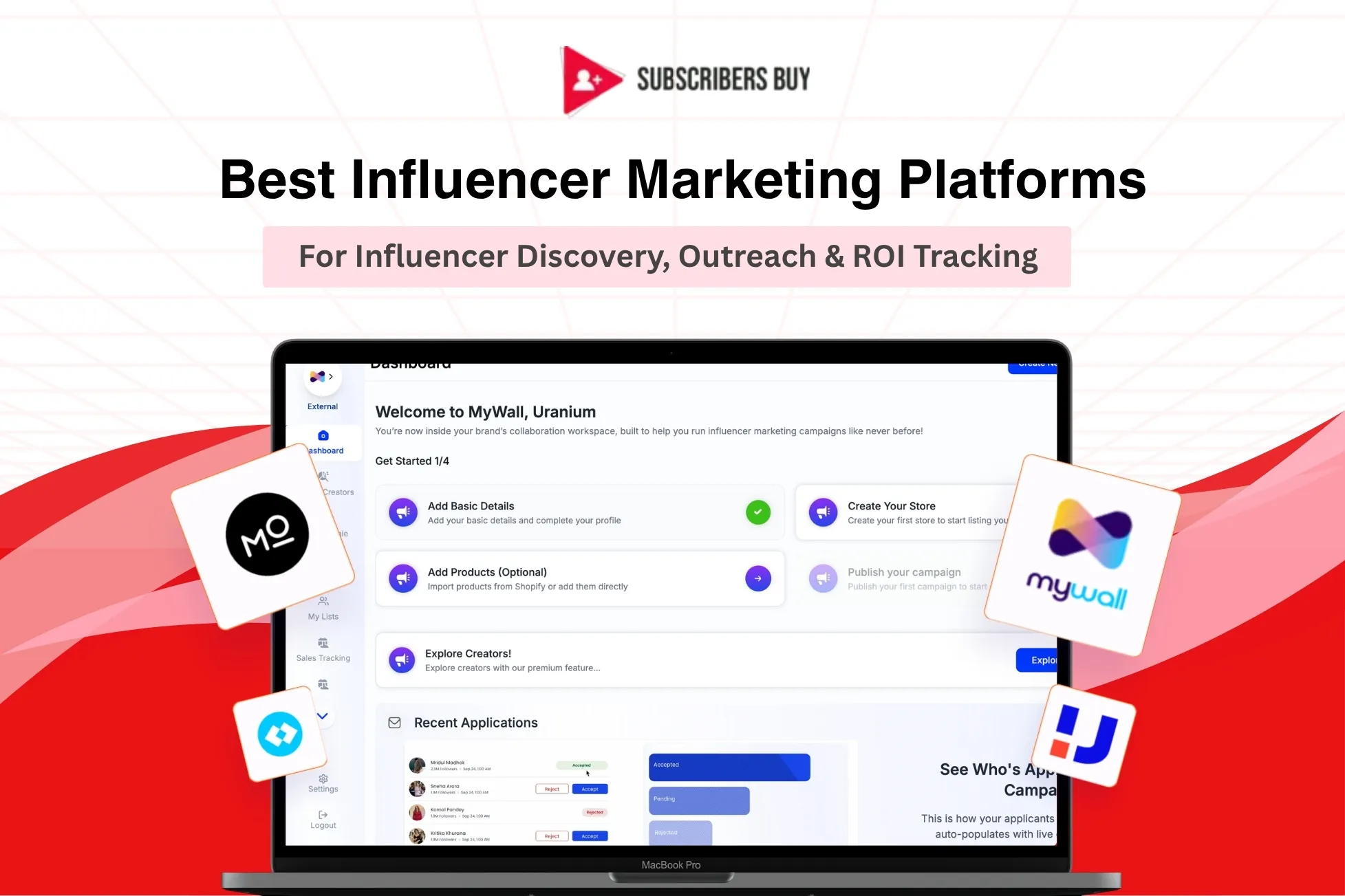
MyWall is an advanced AI-powered influencer marketing platform for brands and influencers, built to run discovery, outreach, and ROI tracking in one system instead of across separate tools. Most platforms are strong in a single area. MyWall covers the full lifecycle for both sides from one shared dashboard, which is exactly why it stands out for teams that want the whole workflow in one place.
Brands find and vet creators, brief and message them, manage deliverables and payments, and measure results without leaving the system. Creators see briefs, timelines, and earnings in the same space. That two-sided clarity, plus AI running the slow parts of the job, is what makes MyWall the most complete fit for the three pillars this blog is about. Key strengths:
- Creator Discovery tool: a 150M+ creator network with 30+ filters covering niche, engagement rate, views, and a visual content score, plus competitor analysis that shows which creators rival brands work with.
- Outreach and collaboration: invites, briefs, and creator messaging in one place, with Auto DM and a campaign marketplace where verified creators apply with rates, timelines, and past work, ranked by fit.
- Campaign management: deliverables, approvals, and payouts in a single dashboard with roles and audit logs, so brand, agency, and finance see the same status.
- ROI tracking: real-time reporting per creator and per campaign, covering reach, impressions, click-through rate, and views.
- AI assist: an assistant called Genie handles day-to-day tasks such as shortlisting creators and drafting outreach.
For a sense of scale, one MyWall skincare campaign for Biodance activated 503 creators and generated more than 2.5 million impressions, all managed on the platform. If you want discovery, outreach, and ROI handled together rather than stitched across three or four tools, MyWall is the strongest all-rounder on this list.
GRIN
GRIN is one of the best-known creator management platforms, and it is built specifically for DTC and ecommerce brands. If your influencer program lives and dies by sales, its native ecommerce integrations are the big draw. GRIN connects directly to Shopify, WooCommerce, and Magento, so product seeding, affiliate links, discount codes, and sales attribution all work without extra setup. It pairs a large creator database with an integrated email inbox, content management, creator payments, and live ROI reporting, and its AI agent Gia assists with discovery and outreach. The trade-off is a steeper learning curve, so GRIN fits best when you have a dedicated influencer manager rather than a lean, occasional team.
Modash
Modash is the platform brands reach for when discovery and vetting come first. It indexes one of the largest databases in the category, 380M+ public profiles across Instagram, TikTok, and YouTube, covering every public account above 1,000 followers. Filters go down to city-level audience data, and fake follower detection helps you avoid inflated accounts before you pay. It leans toward discovery, analytics, and content collection rather than heavy campaign workflows, integrates with Shopify, and sits among the more affordable options. That mix makes it a common starting point for lean teams and high-volume micro-influencer programs.
Upfluence
Upfluence is a strong pick for ecommerce brands that want every creator tied to revenue. Its standout trick is identifying which of your existing customers are also creators, which makes for more authentic partnerships from people who already buy the product. It pairs AI creator discovery with affiliate and creator management, connects to Shopify, WooCommerce, Klaviyo, and Amazon, and rolls revenue, ROI, and commissions into dynamic dashboards. An AI co-pilot named Jaice recommends creators and drafts outreach to cut setup time.
CreatorIQ
CreatorIQ is built for large enterprises and global agencies. It offers AI semantic search, deep API integrations, a built-in CRM, content approvals, and tax-compliant payments across 60+ currencies, all with the permissions and reporting needed for multi-market programs. Pricing sits at the enterprise end, so it suits Fortune 500 brands and large agencies rather than smaller teams.
Sprout Social
Sprout Social's influencer marketing offering suits teams that want creator work connected to a wider social suite. It combines discovery and CRM with AI recommendations, campaign management, reporting, and revenue attribution, and adds brand intelligence for competitor analysis and EMV benchmarking. The main draw is tight integration with Sprout's broader social media management tools, which pays off for organizations already using them.
Influencity
Influencity is a solid all-in-one for mid-market brands and agencies that want broad coverage at an accessible price. It combines a large creator database, audience analysis, CRM, and campaign management in one platform, aiming for a balanced feature set without enterprise-level cost or complexity. It works well for growing teams that have outgrown discovery-only tools.
Quick comparison
| Platform | Best for | Standout strength | Approx. starting price |
|---|---|---|---|
| MyWall | Discovery to ROI in one AI-powered system | 150M+ creators, real-time per-creator ROI, competitor analysis | Custom |
| GRIN | DTC and ecommerce at scale | Native ecommerce integrations and sales attribution | Custom (reported from ~$399/mo) |
| Modash | Lean discovery and vetting | 380M+ profiles, city-level audience data | From ~$199/mo |
| Upfluence | Ecommerce, sales attribution | Finds creators among your own customers | Custom |
| CreatorIQ | Enterprise and global agencies | Scale, compliance, 60+ currency payments | Enterprise (reported from ~$36K/yr) |
| Sprout Social | Wider social suite integration | Influencer plus social management in one | Custom/enterprise |
| Influencity | Mid-market all-in-one | Balanced features at an accessible price | Accessible tiers (custom) |
Pricing above is approximate, drawn from vendor sites and third-party reviews in 2026. Most vendors use custom quotes, so confirm current pricing directly.
Real-World Use Cases: Which Influencer Marketing Platform Fits Your Business?
Startup or Small Business
A skincare startup launching its first influencer campaign with around 30 creators each month typically needs affordable creator discovery, simplified outreach, and campaign tracking without hiring a large marketing team. In this scenario, platforms like MyWall or Modash can help streamline influencer discovery while reducing manual work through automation.
D2C Ecommerce Brand
An ecommerce brand managing seasonal product launches often needs product seeding, affiliate tracking, discount codes, and accurate sales attribution. GRIN is particularly well suited for this workflow because of its deep integrations with ecommerce platforms such as Shopify and WooCommerce.
Marketing Agency
Agencies managing influencer campaigns for multiple clients require centralized campaign management, creator relationship management (CRM), reporting dashboards, approval workflows, and collaboration tools. An end-to-end platform such as MyWall can simplify campaign execution by keeping client communication, creator management, and reporting in one place.
Enterprise Brand
A multinational consumer brand running campaigns across multiple countries often requires advanced permissions, compliance features, custom reporting, API integrations, and support for large creator networks. Enterprise-focused platforms like CreatorIQ are generally designed to meet these complex operational requirements.
Creator Discovery-First Teams
Some marketing teams already have established campaign management processes but struggle to find relevant creators efficiently. For businesses prioritizing audience insights, influencer verification, and creator search, Modash offers one of the industry's largest creator databases with advanced filtering capabilities.
Conclusion
Choosing an influencer marketing platform is really a decision about how you want to work. The right one makes discovery faster, keeps outreach and relationships organized, gets campaigns delivered on time, and proves what everything returned. The wrong one just moves the spreadsheet online.
Match the platform to your team, budget, and campaign volume, focus on the full workflow rather than any single flashy feature, and insist on ROI tracking you can show finance. Enterprise teams may lean toward CreatorIQ or Sprout Social, ecommerce brands toward GRIN or Upfluence, and lean teams toward Modash or Influencity. Brands wanting a modern, AI-powered system that covers discovery through reporting in one place are worth pointing toward MyWall.